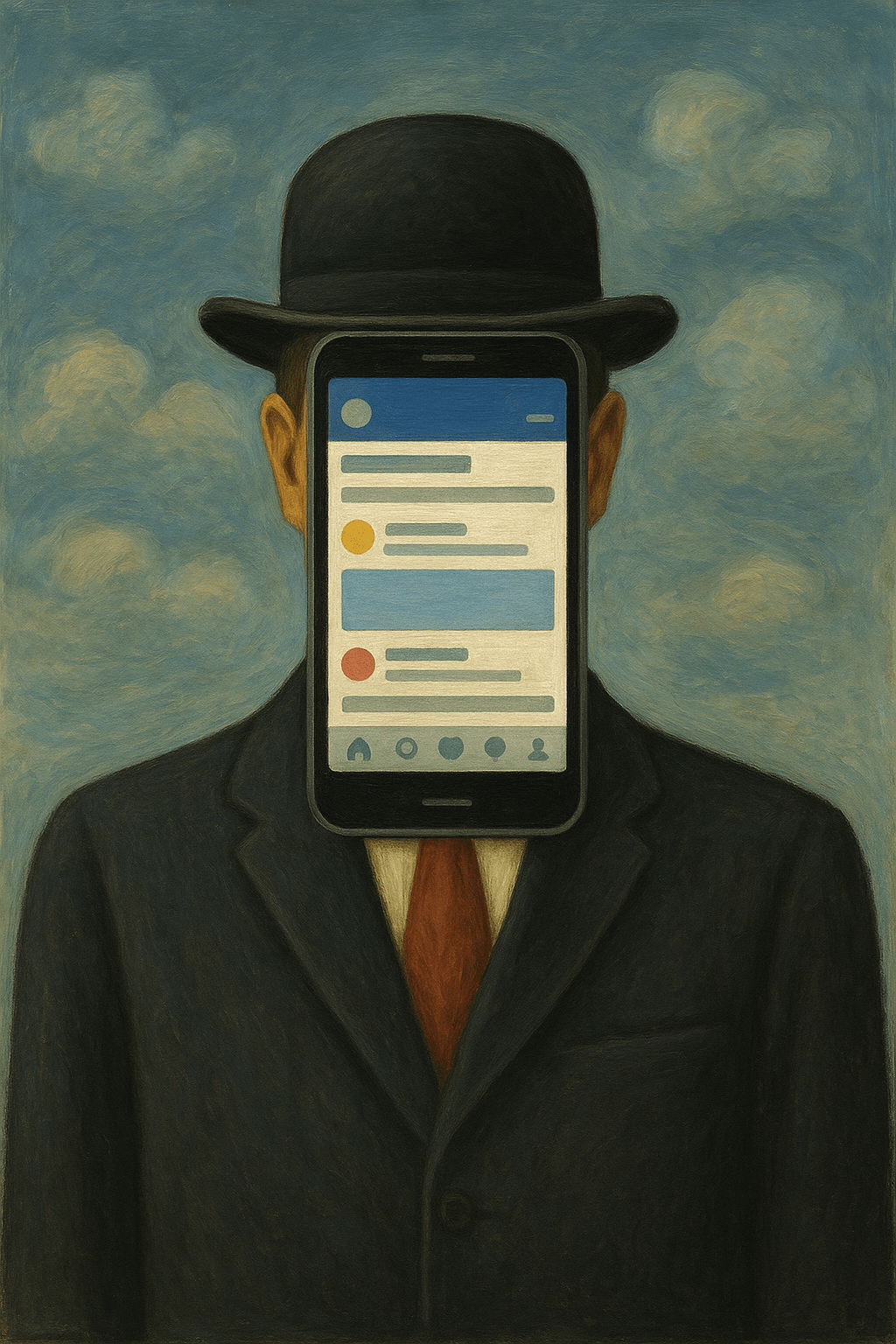
Unbeknownst to him, Alfred found himself once again trapped in the algorithmic web. Out of nowhere, he found himself scrolling restlessly, watching a bizarre, random sequence of unconnected posts: a colour map of Christianity numbers in the US, followed by a headline with an image of James Webb Space Telescope’s discovery of the most distant Fast Radio Burst, followed by a meme ridiculing how engineers use ChatGPT in tech companies, followed by some out-of-nowhere Asian cute babies? Whatda?
Alfred liked to scroll, but he was at times troubled by it all. He was troubled by the thought of who or what or how the particular order of the content he was fed was chosen, or whether it was chosen at all. Granted, he understood most of it reflected his own personality, ideas and interests, his previous searches, but why in particular that map of Christianity? And those random Asian cute babies? Where did they come from? He had seen them far too many times now. He could not deny their cuteness, but, why Goddammit!? “Why on Earth am I shown this!?”
Those babies troubled him particularly. He would encounter them on his feed from time to time, different babies each time, perhaps even AI-generated, captioned in Chinese characters. They enraged him. He was sick of them. “Fucking stupid algorithm.” He then proceeded to scroll through them, only to find them five posts later down the line, triggering the same thought pattern again.
Alfred was aware he did not have direct control over the algorithm choices. He was aware he could not tell the algorithm directly: “Look algo, these babies, cute, one time, fine, but now I’m sick of them, please stop placing them on my feed.” He nevertheless had noticed something. He still did not understand how the algorithm worked, but over time, after observing it and interacting with it for long, he had built an intuition as to what made the algorithm choose certain type of content over other. He had noticed that although he could not choose what to watch, he could nudge, or steer the algorithm in a particular direction.
At first, he thought it was agreeableness that dictated the algorithm’s whims. He noticed the content he liked was often echoed more strongly in his feed. But he too saw that often he was presented with political content which enraged him, and the hate and anger seemed just as effective as agreeableness in steering the algorithm. That struck him. He could not understand it. Why was the algorithm showing him content he didn’t like? Even those fucking babies. God, he hated them with passion. But they were so cute…
But that was not all. There was another aspect of his interaction with the algorithm that troubled poor Alfred. Sometimes, the scrolling was so absorbing, so immersive, that he forgot what he was doing or about to do. Sometimes, he became so absorbed that he totally forgot he was “being”, wherever it happened to be he was “being”.
That “forgetfulness” concerned him. He was spending too much time absorbed in that unfolding cacophony of content. It was so engaging, yet so disturbing, that it was cluttering his mind, preventing him from thinking clearly. He felt restless. He had trouble concentrating or focusing on the “present”, because the temptation was so strong, and the whole process so absorbing that, unwittingly, time and again he got carried away in the algorithmic flow.
Alfred was desperate. He started to feel as though he was almost losing control of his own self, of his own free will, slowly being overtaken by the algorithm. Helpless, he sought help. And his feed, once his worst enemy, had for once become his best friend. First intertwined between the discovery of the Telescopefish and a delicious chicken butter masala recipe, he had seen an ad of a therapist specializing in social media mental health issues. And then he had seen it again. And again. Until he pulled the trigger. He wasn’t clear whether he had made that decision or whether the algorithm had chosen for him, but he didn’t care. All he wanted was to free himself from the endless scrolling and regain a sense of calm and clarity.
“So tell me Alfred, what’s the matter?” — asked the therapist.
“Well, as I said in the form, I feel the algorithm is overwhelming me, I feel I’m losing control of my own thoughts, as if I were no longer in control of my own self. And there’s all this stuff I see online that troubles me.”
“What is it that troubles you in particular?”
“It’s these things the algorithm shows me, not knowing where they come from, I want to understand where they come from. Like I keep seeing these stupid Asian kids out of nowhere, and I want to know why they’re there in the first place. It’s not like they’re disturbing or anything but the fact that they are part of my feed IS disturbing.”
“Right I understand how that can be disturbing.” — said the therapist.
“And the other thing is that sometimes I get so hooked that I completely lose awareness of myself. I become so absorbed that it is as if I had lost myself in there, I become trapped and unaware of anything else.”
“I understand how that can be frustrating.
Look Alfred, I think it might help you to understand a bit how your own mind works, because social media algorithms work much like our own ‘minds’. Have you every practised meditation?”
“Not really.”
“Have you ever wondered where your thoughts come from?”
“No…”
“Have you ever been so absorbed by your own thoughts that you lost track of a particular situation?”
“Yes, I’ve experienced that.”
“Doesn’t that sound a lot like what you just told me?”
“I guess.”
“Wouldn’t you say your thoughts, much like the content you see, are a reflection of your personality, culture, past experiences and so on?”
“Yes, I can see that.”
“I’m going to give you a little homework for today. When you go back home, I want you to sit down in silence, close your eyes and do nothing. While you do that, I want you to pay close attention to whatever goes on through your mind. Try not to get too carried away by your own train of thought, try to step back and observe it as it unfolds.”
“I don’t understand what this has to do with my social media problems.”
“I can see how this sounds confusing right now, but trust me. You’ll be in a better position to understand what I have to explain you. I’ll see you again tomorrow.”
The next day, Alfred went back to the therapist.
“So, how did it go?” — asked the therapist.
“Well, it was weird. I had never paid that much attention to my own thoughts.”
“What did you notice? Any thoughts in particular?” — asked the therapist.
“Well it was a mess. I could feel my mind going back and forth between ideas, things that had happened during the day, reflecting on our conversation, and many other things. Like five minutes into it, I completely lose track of the exercise and started to daydream basically. But I’m still not sure how this is relevant to my problem.”
“That’s perfect. Did you, at any point, wonder where a particular thought came from? Did you ponder about the exact order of the thoughts you had?”
“Not really, no.”
“Then why do you that with what you see on social media?
You see Alfred, what you have just experienced are the inner workings of your mind — you’ve just had a close look at your own ‘feed’. You’ve just had a scroll through your very own thoughts.”
“What?”
“Your problem Alfred is not seeing a particular piece of content — it’s obsessing over it. This is also the source of much suffering in the world, just that what people obsess over are particular thoughts. But this problem was solved by Eastern philosophies millennia ago. The source of most of our troubles is a complete misunderstanding of the nature of the mind. When it comes to recurrent thoughts, it doesn’t matter whether we like them or not, but whether we engage with them. And whether this engagement stems from jealousy, hate or anger, it doesn’t matter. The algorithm is just operating under this same principle.
So what do you think you have to do to stop seeing these pieces of content?” — asked the therapist.
“Hmmm not sure as I don’t have any control over what the algorithm shows me.”
“That’s right but even if you don’t have control over what exactly the algorithm shows you, and I understand that can be frustrating, instead of staring at the content you hate, try not paying attention to it. When it comes to thoughts, it is OUR attending to SOME thoughts which fuels them, which signals the mind to produce those even more often. The mere pondering of “Why do I have this thought?” or “How do I change this thought?” is not even the right framework to start with, because all we do is generating even more engagement, more attention to that particular thought, which branches out and propagates into a myriad of sub-thoughts. I would encourage you’d better let go, don’t obsess over why that particular piece of content is on your feed — it’ll go away the moment you learn to ignore it, because that’s exactly how the algorithm works too.”
“Really? Simple as that?”
“Yes, in fact this is exactly how we deal with UNWANTED thoughts. There’s nothing to be done. All we have to do is scroll through them, let them pass, let them go back the way they come. In doing so, the algorithm of the mind, slowly, understands those thoughts are not useful, and over time, stops producing them altogether.”
“Wow I had never thought of it that way!”

And from that point on, Alfred not only solved his problem by simply letting go, but started to pay attention to his inner algorithm, reaching a new perspective about his own nature. From time to time, he was able to step back from the torrent of noise and see clearly that he was not those thoughts, nor a biological feed, but something grander. He existed somewhere higher, sitting above the clouds, watching them pass. And this is how, slowly, Alfred, by attentively observing his own mind, by observing the mind for what it truly is, an erratic, nearly random-thought generator, came to understand it, gaining an inner sense of calm and clarity.
 Andrés Gúrpide Lasheras
Leave a comment