There’s no “opting out” of AI. The only option is to automate your work away
These were my thoughts/feelings in early 2026. I’m still not fully certain how to feel about AI. At times, I do still feel this way, but there are convincing arguments to be made against AI taking all of our jobs, which I plan to write in a separate post soon.
If you are reading this, chances are your job involves the creation of some form of digital work —code, forecasts, reports, articles, music, websites, designs. Congratulations, you’ve just boarded a train you didn’t choose to. One that keeps getting ever faster. The destination? Joblessness. A crushing feeling of uselessness.
You are soon to be dispensed with. You’re about to find yourself in a society where you have nothing to contribute, at least not in the way you were used to, or worse, the way you enjoyed.
How will it feel? Well, think of a pensioner, without a pension. But unlike a pensioner, which can take pride in having devoted a lifetime to the betterment of society, you will be made redundant by an algorithm, one that can do what you do faster, better and cheaper.
So, what are your options?
You could gain some more skills or enhance your productivity in an attempt to outsmart the machine, hoping to remain valuable in the AI era. This is like running backwards on the train, you may delay the arrival, but the train keeps getting faster. As we speak, machines are becoming better and better, trained by millions of people worldwide who are happily giving away their thoughts, intelligence and creativity, in exchange for convenience.
Really, you should ask yourself, what is your edge? An AI can digest information at light speed with near-perfect retention. It has unlimited attention and energy, and it can seamlessly interact with computers, because it IS the computer. Meanwhile, you are a sluggish and sloppy reader, retaining only a fraction of what you read. Learning anything takes you considerable time and effort. Your attention drifts, you get tired, you need breaks. And worst of all, you need to constantly go on Stack Overflow to remind yourself how to replace characters across files using regexp.
Perhaps you are one of those that finds comfort in that “AI makes mistakes” and that “a human will be needed to review the output”. Please.
First, an AI doesn’t need to make zero mistakes. It just needs to make marginally fewer mistakes than a human — it is still faster and cheaper. But really, even this is delusional thinking, hasn’t Claude been trained on the accumulated work of millions of programmers? Hasn’t its coding capacity already surpassed that of any individual human?
Secondly, the idea of a human reviewing the output seems logical at first, but another AI can equally be trained to review the output. Or even better, you can tell the same AI to review itself. I mean, how come we’ve already automated tasks that 10 years ago seemed impossible, and the argument for the human in the loop is that the most menial, repetitive and tedious task of reviewing output cannot be automated?
Moreover, humans, blinded (or forced) by competition, will just have AI climbing up the automation ladder, so the argument is in fact the opposite: humans still in the loop today won’t be there for long. Meta is already tracking employees’ mouse movements and keystrokes. xAI, Elon Musk’s AI company behind the MECHAHITLER — sorry, Grok — is trying to build a human “emulator”. Meaning, if you’ve ever been impressed by Claude’s capabilities, imagine a fully-fledged digital worker. Not an agent that can code better than you, but an agent that can literally do EVERYTHING you do on a computer? Only faster. Without breaks. No more monkey errors.
This is what makes this tool different: it is self-improving. Previous automatization waves focused on limited or narrow tasks. Instead, the breadth of AI automation is expansive.
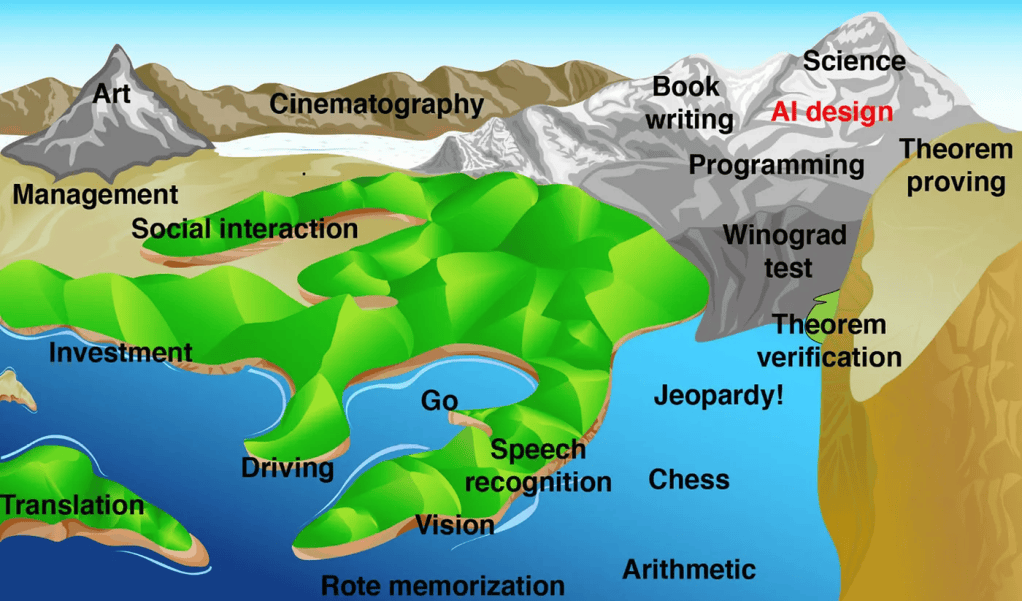
How about refusing to use these tools then? This is like stepping off the train entirely. Congratulations, someone using AI has just outsmarted and replaced you. If it makes you feel better, know that soon enough that person using the AI will be replaced by the tool — like those Meta employees, who are, ironically, working furiously to automate themselves away.
So you have no options. We are all stuck, powerless, witnessing our own redundancy unfolding. And the worst is that you cannot opt out. It is a classic example of the Prisoner’s dilemma: just because someone uses it, you are forced to use it.
What does the endgame look like? How will it feel to live in a world where you have nothing to contribute? Where you have been discarded, like a used tissue?
“Sorry, we don’t need you any more”.
Capitalism once depended on extracting surplus value from human labour. This gave workers some bargaining power. Now we’ve figured a way to extract labour while eliminating the human: extract skills, expertise and knowledge (for free), freeze them digitally, and discard the human afterwards. Is AI enabling capital owners’ ultimate goal: full ownership of fully automated means of production?
One can always wonder how much “freedom” we truly have, how much control the government exerts on us or how much big corporations enslave us, but there’s no denying that the capacity to choose a fulfilling job and the empowerment of having the agency to earn your own money is part of that freedom. Is the full automation of cognition a threat to our freedom then? Will we be begging for universal basic income, after our cognition has been digitally extracted?
It feels to me we are all unwittingly contributing towards this goal. Some experts liken us to horses in the early 1900s, which went from a useful mode of transportation to mere domesticated animals once they were replaced by gas-powered vehicles. Are we, too, to become domesticated animals — dependent, and economically unnecessary — like the Unabomber warned us in his 1995 manifesto?
Will we scramble for the last remaining jobs to squeeze the last drops of sense of purpose, in a society obsessed with automation that inexorably drove itself into a meaningless existence?


Leave a Reply