It might even create new ones
You’ve heard it a million times — “AI will cure all our diseases”. It’s an idea often touted by proponents of AI when discussing the many benefits the technology will bring about. Dario Amodei (“We Must Pace the Frontier”), Marc Andreessen (“Why AI Will Save the World”) and Demis Hassabis have all made similar claims. It’s an assertion so casually made that we don’t even stop to think about it, because it feels true. And it feels true because AI is exactly the type of magical technology Arthur C. Clarke wrote about: the genie from the lamp. Ask for whatever you wish — consider it done.
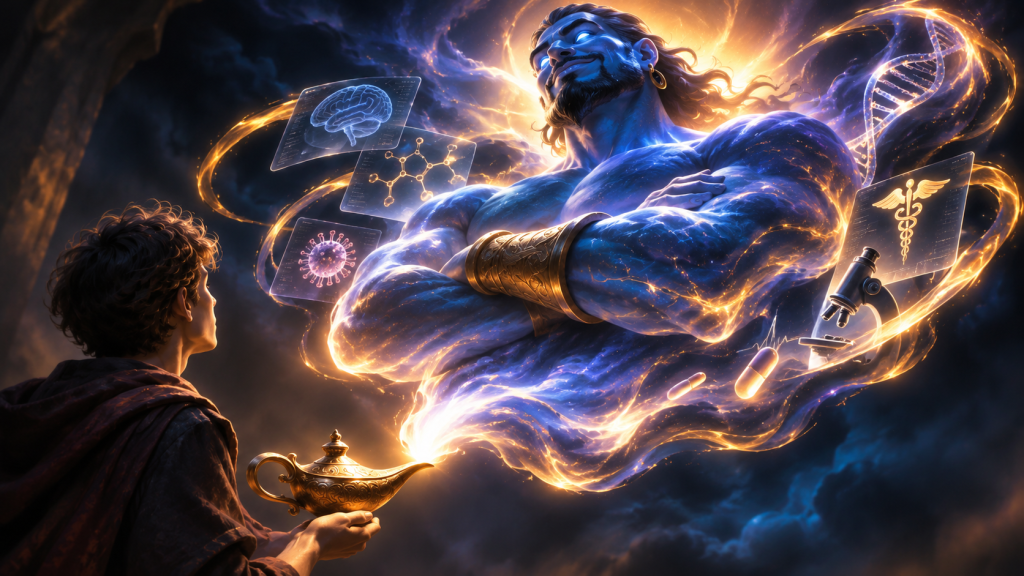
I myself had never given much thought to those statements. They felt plausible. After all, who is this flesh and blood Homo sapiens to question what unlimited superintelligence will be able to accomplish?
But on second thought, I think it’s hard to make a case for a superintelligence entity giving us the long-dreamed-of disease-free technoutopia.
You see, believing AI will cure all our diseases rests on (at least) two premises: I) that there exists a finite amount of diseases and II) that a “solution” — a pill, an operation, a treatment — exists; we just haven’t found it yet. But if the last decades have taught something is that I) is almost certainly false and II) is far from guaranteed.
Premise I: There is a finite amount of diseases affecting humanity
The thing is that there’s no finite set of ailments affecting humanity, rather, society — or as experts put it, civilization — continually creates new diseases as it evolves. Experts talk about diseases of civilization — diseases that were absent or largely nonexistent in hunter-gatherer or pre-industrial societies, and which result from an evolutionary mismatch, substance abuse or pollution.
My favourite example is Type II diabetes — the type of diabetes you can develop through a bad lifestyle. It was once called “adult-onset diabetes” because well, it took really some years of bad habits to develop an insulin resistance. Now it turns out that if you really try hard and feed kids an unhealthy amount of sugar and fast food they too will develop diabetes: the “adult” in adult–onset diabetes no longer reflected reality; the disease had to be renamed [e.g. 1]. Not only was “adult-onset diabetes” already a much more prevalent disease in a sedentary society heavily reliant on technology and poisonous food, we managed to make it worse.
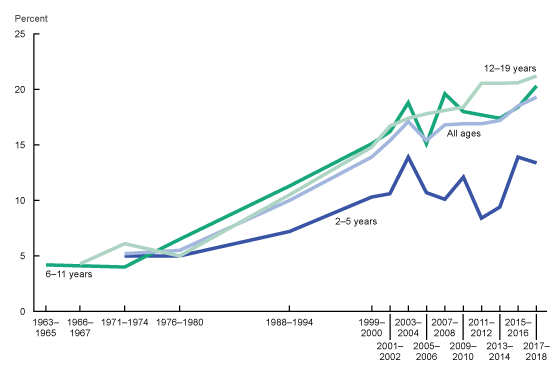
Obesity, strokes, heart diseases, dementia or some type of allergies, to name a few — they are all heavily influenced by our lifestyle or environmental conditions. And even if you were to cure some of these, these just so happen to be the diseases of civilization of our current way of life and stage of technological development. They will keep on changing, and pretending you can cure them all is like claiming you can win an infinite game of wack-a-mole.
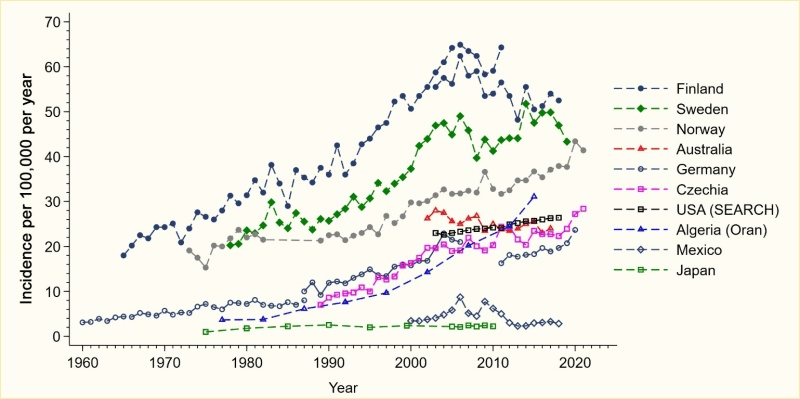
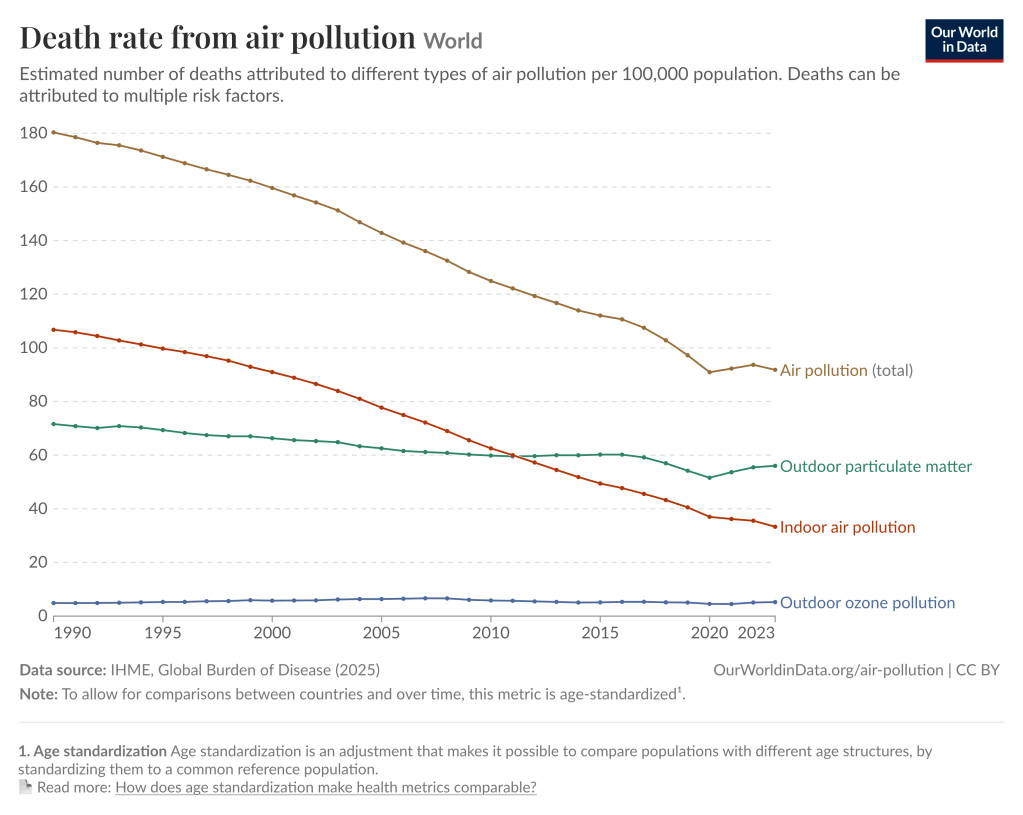
There are several examples of environmental or technological changes driving new diseases, worsening or improving existing ones. Type I diabetes — an autoimmune disorder where the body attacks its own insulin producing cells — is a good example of a disease being made worse in the last decades by some environmental change. On the other hand, while air pollution continues to be a massive health burden (second leading risk factor for death after high blood pressure), improvements in manufacturing technologies, renewable energies and households shifting away from solid fuels for cooking and heating have helped reduce pollution in many parts of the world.
More on the technological side, “ocupational burnout” is a term I had barely heard a few years ago— and trust me despair runs high in academia [2,3]— yet more and more I hear from acquaintances having to take time off as they succumb to work pressures. Rates of burnout have increased among health workers in recent years and Glassdoor — the Tripadvisor of work places — reports the word “burnout” is on the rise on their reviews. The same trend appears if we look at Google trends for “burnout symptoms”. In 2019, “burnout” was included in the WHO in its International Classification of Diseases.
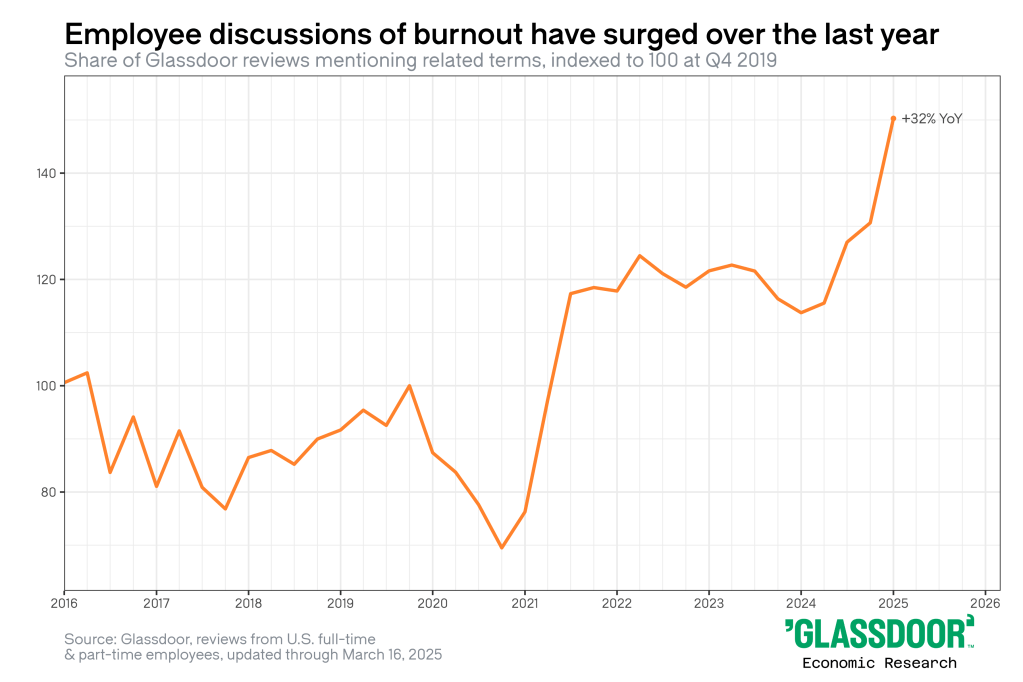
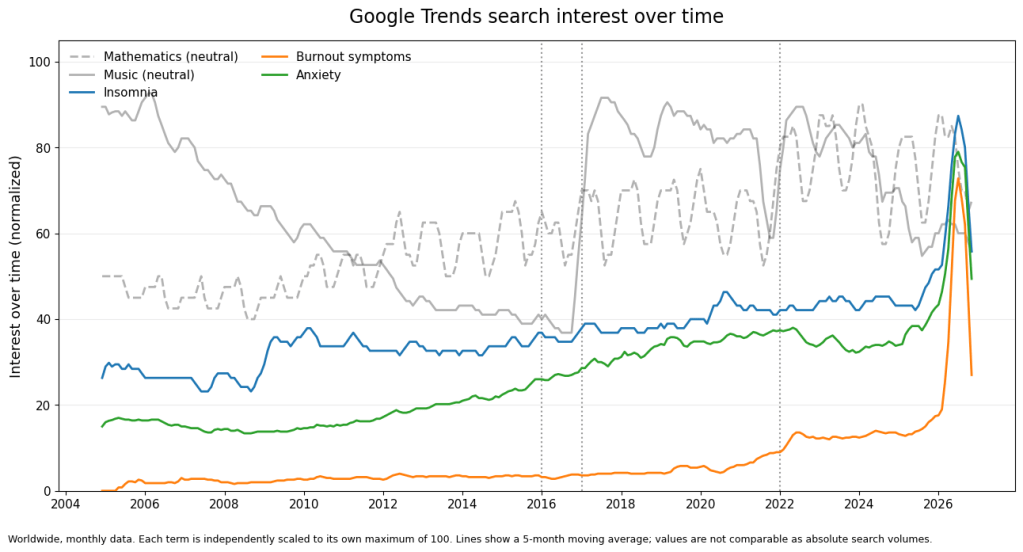
Now why people are ‘exactly’ blowing up at work is likely due to a complex combination of factors, but the pattern is similar everywhere: a feeling of having to be always on, constantly checking emails and notifications, and a blurring of the boundaries between home and work life. Conditions that have become possible on an entirely different scale thanks to modern technology.
Society is full of examples where current technology is messing up with our biology, often in ways we still don’t understand fully: microplastics, now even in your testies; outdoor air pollution, a recognized potential risk factor for dementia and many other cognitive functions; blue LEDs from screens, tricking our brains into thinking it’s still daytime, delaying melatonin production and disrupting our circadian rhythms; and social media, overstimulating our brain’s reward circuitry, making us use it compulsively, leaving us more anxious and depressed [4, 5], and giving us ADHD-like symptoms [6, 7, 8]. The highly-personalized portable casino just happened to hijack our dopamine receptors, but who is to say that a new Sillicon Valley invention won’t make us suffer from serotonin dysregulation?
At their very core, diseases of civilization arise from a mismatch of our evolutionary biology and our environment. We evolved to move in nature, hunt, forage for plants and fruits, and endure hunger, not to sit on the couch covered in Cheetos® watching Netflix all day long. Our neurochemistry evolved to compel us to seek food, mate, explore our surroundings, take on hard challenges and rest, not to endlessly scroll through feeds and digitally overload our brains. Diseases of civilization are just a reminder that we cannot bypass our own nature, and so long as our (artificial) environment remains unmatched to our biology, we will keep on suffering.
Premise II: A “solution” exists to treat all diseases, we just haven’t found it yet
The irony about touting AI as a solution to all of our diseases is that in many instances it’s not a lack of knowledge preventing to cure many of these, but simply an unwillingness or incapacity to change ones’ habits or environment. The US life expectancy stalled in 2010, is it a lack of knowledge or intelligence that maintains their population unhealthy? In fact, it is ironic that many of these modern treatments e.g. weight-loss medications are created to precisely compensate for the mismatch between biology and environment we’ve created in the first place.
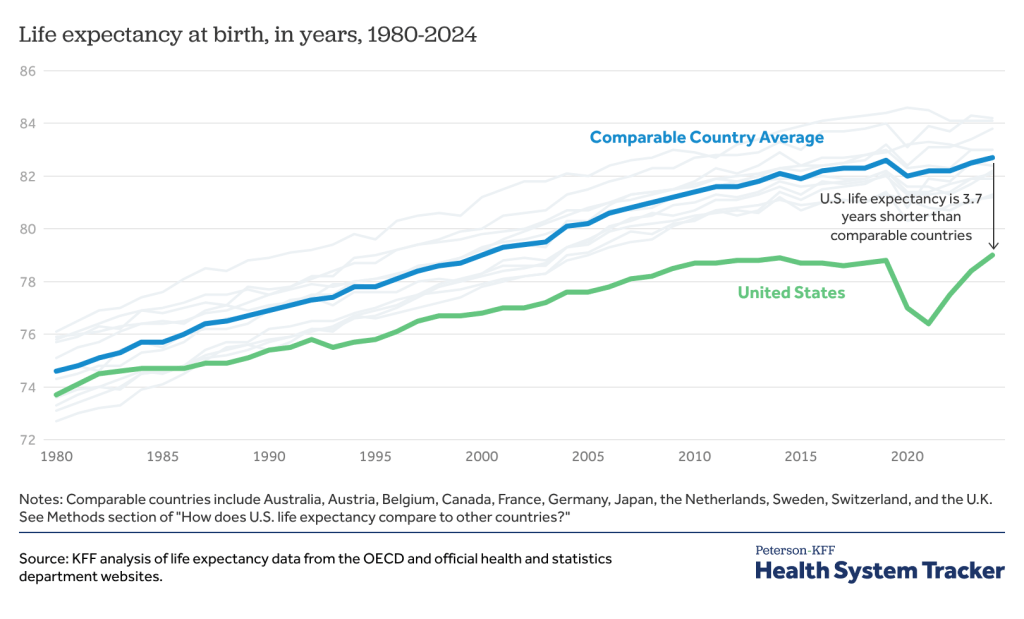
But even if you could pill your way out of e.g. obesity or air pollution, it’s hard to think you can circumvent your biology. The nature of living things is to seek homeostasis — internal balance against the environment. If something external is introduced to the body, something must give in. There will be some adverse effect somewhere. So we may find treatments to alleviate the symptoms, but these will remain patches as long as the underlying cause — the environment or lifestyle choices — remains unchanged (hence why people on weight-loss medication regain most of the lost weight after discontinuing treatment).
So will AI solve all of our health problems?
There’s yet another irony about touting AI as the solution to our health problems. You see, if social media has taught us something, is that we can create technologies faster than we can understand their consequences. AI won’t be any different — the technology will in all certainty bring with it an array of diseases we’ve never experienced before. AI psychosis, AI fatigue — these may just be the trip of the iceberg. We have no idea how the technology is going to affect our e.g. already saturated attention and cognitive capacity; only time will tell.
So I’m skeptical AI will lead to a disease-free society. In the last decades, despite modern medicine eradicating a plethora of infectious diseases, the youngest generations are more stressed and anxious than ever. While I have no doubt the technology will be immensely valuable in accelerating cures to many modern diseases (and in particular infectious ones), to claim it will cure all our diseases ignores the ever-evolving relationship between diseases, society and technology.


Leave a Reply